We Naga Sadhus are an artefact of an ancient world populated by Gods, Demons, great kings and queens, bit players in cosmic dramas; witnesses, and therefore storytellers, of the great tradition of the Sanātana Dharma. In the Tretā Yuga, in the age of the Rāma Kathā, we emerged out of our jungle ashrams and Himalayan caves to come to the feet of Lord Dattātreya, the son of the Rishi Atri and Anasūyā Mātā (the personification of Female Śakti), for His protection and guidance, and His spirit entered our bodies so that the guru-śiṣya paramparā, the tradition of discipleship, would continue through the ages, preserving His spirit and establishing a collective witness of the world. Possessed by His spirit, we emulated Him in our lifestyle, appearance, and discourse, with His special emphasis on irony — and this intellectual and spiritual culture, steeped in the Vedas and their performance, gave us our unique identity.
According to our oral histories and records of our maṭhas, the great commentator of the Vedas, Ādi Śaṅkara, in the 5th–6th century B.C., having made his conquest of the four directions, his digvijaya, called us together from the 4 corners of Bhārat to establish for us a monastic-like organisation formed on Vedic principles, with maṭhas in those 4 corners, and lineages based on the names he gave to his first śiṣyas. Up until that time, our initiations were based on the giving of guru mantra and other sacraments by 5 gurus, continuing the guru-śiṣya paramparā, all 5 being the witnesses of Guru Dattātreya, whose spirit enters our bodies. Ādi Śaṅkara added an additional dīkṣā, a saṃskāra of sannyāsa, which takes the form of a yajña, and formally cuts our ties with our birth obligations and families, and establishes us in a formal monastic order consisting of ten great lineages bearing ten names, called the Daśanāmī Sannyāsīs.
By the end of the 7th century A.D., those of us Sannyāsīs who maintained not only the lineages of Guru Dattātreya, but also His personality traits, established a sacred circle consisting of 51 branches, sub-lineages of 4 of the 10 lineages of Daśanāmī Sannyāsīs, namely Giri, Purī, Sarasvatī, and Bhāratī, which became known as Dattātreya Akhara in Ujjain and Bhairon Akhara in Varanasi, even being the same sacred circle. We became known as Naga Babas — naked in ashes, kings on straw mats, tending our dhunis and giving blessings as we always have done. During the next 1000 years a number of new akharas appeared with lineages within the Daśanāmī order but of different sub-lineages from those of Guru Dattātreya. Our akhara, the original one, whether Datta Akhara or Bhairon Akhara, became known as the “old akhara,” which in the Gujarati language translates to “Juna Akhara.”
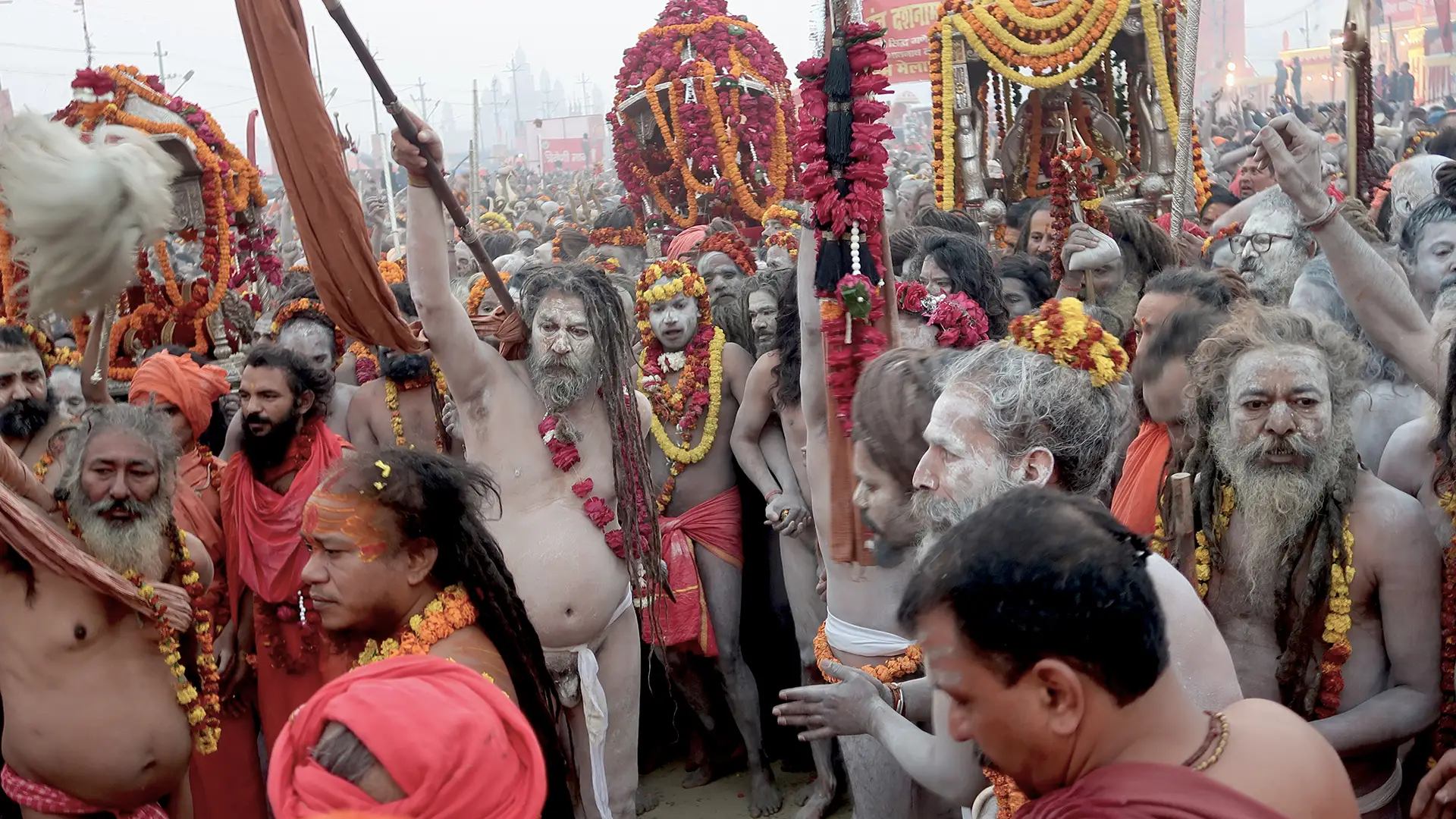
In the 1860s in Varanasi we were registered as a society, which is more accurate than thinking of us as an order, a sect, or even an organisation. There is no doctrinal orthodoxy or discipline. Authority is maintained in the families within sub-lineages, except during Kumbh Melās, when all the families come together and the Akhara establishes a formal encampment. The Akhara uses the occasion of the Kumbh Melā to elect functionaries and 4 special groups of 5 Naga Babas, each pañcāyat led by a Śrī Mahant followed by an Aṣṭakosūl Mahant, his lieutenant, a pujārī, a bhaṇḍārī, and a karwārī. The akhara is divided into 4 sections called maḍhīs, branches: the 16 maḍhīs, the 13 maḍhīs, the 14 maḍhīs, and the 4 maḍhīs (actually 4 maḍhīs each of Sarasvatī’s and Bhāratī’s) — each section led for 3 years by the pañcāyats, who are charged with serving our Devatā, Guru Dattātreya, and moving Him from place to place, on foot, between Kumbh Melās. The Kumbh Melās are also the prescribed venues and times for the making of new śiṣyas, as well as for the unique Naga Saṃskāra. The oral tradition of Guru Dattātreya is passed on in this way.
I have been lucky and blessed to have witnessed a world of Naga Babas, in which the line between Gods and humans becomes blurred, in which mythology invades daily life, and miracles are to be expected. Having watched the paramparā add generations for well over 50 years now, I’ve seen how the actual vyaktitva, the very persona of the Naga guru, enters the śiṣya, who in turn passes that spirit of Dattātreya to his śiṣya.
My own saṃskāra was completed with numerous baths on the banks of the Gaṅgā on a cold, foggy Thursday morning (Guruvāra), Makara Saṅkrānti, January 1971, and the whispering into my ear of the Mahā Mantra by our Ācārya Mahāmaṇḍaleśvara. And so I, too, became — unknowingly at the time — a witness of all of that which would follow: an ancient oral tradition in collision with a modern, and then a post-modern, world, and somehow fated to be a storyteller of that tale.
Further on this site: a photographic record of the Naga Babas of Juna Akhara, portraits of several legendary Naga Babas, and the story of the Aghori Baba Ram Nath.