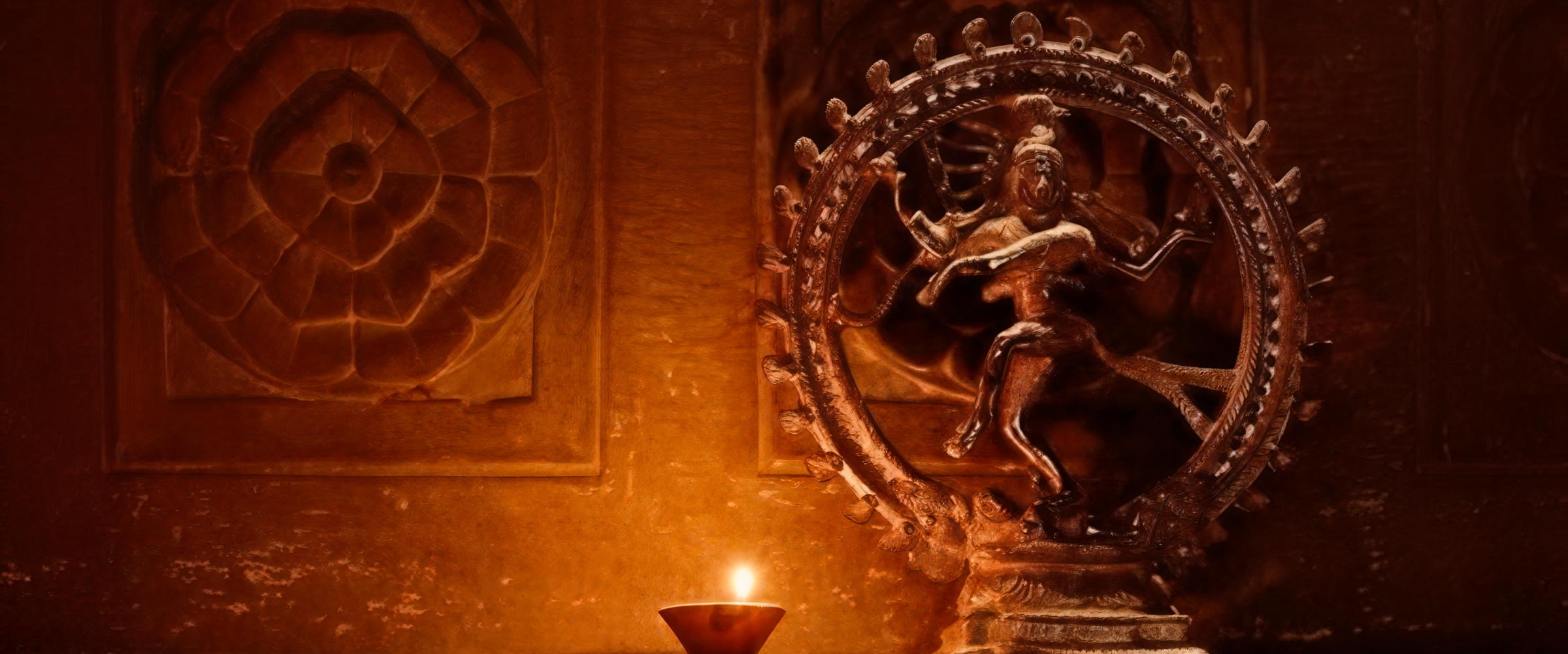
VII · Shiva: His Drum of Consciousness
This conversation falls on the eve of Maha Shivaratri, recorded on the Trayodashi, the thirteenth dark night of the moon, the day we prepare for the night to come. Maha Shivaratri is the single most important date, not for the worshippers of Shiva alone but for everyone in the Indian traditions of knowledge, the esoteric, the musical, the shamanic, the alchemical, anything hidden from ordinary view; for it is the night on which what is hidden becomes revealed. Its true worship and the quest for hidden knowledge take place after midnight, and its great vow is wakefulness: the devotee stays awake through rituals, bhajans, kirtans, and satsang until the fourth and final puja at dawn. And it bears on speech itself, for on this night the visarga, the echo, the mirror syllable, is reduced, so that the visarga of Shiva’s “ah” (अः) sounds only as a half “ha” (ह), a reflection.
There is a parable I tell on this night. An evil hunter, passing a village in the midst of its Shivaratri festivities, scoffs at the devotion of the faithful and goes off into the forest to kill a deer, where he is himself stalked by a tiger. He climbs a Bilva tree, whose leaves are most dear to Shiva, and in his fear he stays awake all night; as he shifts and spits, Bilva leaves and water fall from the branches onto an ancient Shivling hidden in the weeds at the foot of the tree. By dawn the tiger is gone, and the hunter, without knowing it, without any devotion at all, has kept the whole vigil and made the full Shiva puja of Maha Shivaratri, and he is liberated. Such is the irony of the night.
From there I return to the five vargas, the five stations, and open each. Inside a varga we start with the simple striking, ka (क); the second member is its aspiration, kha (ख); the third is an expansion of the throat, ga (ग); the fourth is that expansion of the throat with aspiration, gha (घ); and the fifth is a nasal, where we reroute the articulation through the nose instead of the mouth, ṅa (ङ). Five members in each of the five vargas give twenty‑five consonants. To these are added a set of four, the Antastha, the semi‑vowels ya (य), ra (र), la (ल), va (व), where ya, for instance, comes from putting the vowel i (इ) before a (अ).
Then I come to the heart of it, the syllables Pāṇini (पाणिनि) received in his darshan of Shiva on a Maha Shivaratri night some twenty‑six hundred years ago, or three thousand, who knows when. When the Lord beats His ḍamaru, the drum of consciousness, it sounds the fourteen Māheśvara Sūtras (माहेश्वर सूत्र), and within those fourteen are held the fifty syllables of Sanskrit speech, with one more, kṣa (क्ष), added in the Tantric. I give them slowly, so the ear can find each syllable. This is one of the most powerful collections of syllables on the planet; without its revelation to Panini, the road to our own computer revolution would have run another way entirely.
There is a system here, an ancient one, that the West would not arrive at in speech until the nineteenth century, and its basic order is twisted and turned to many esoteric uses. But to enter it you must think in syllables rather than letters. So I ask you to learn the Devanagari, which is far easier than you fear; Roman transliteration, for all its diacritical marks, keeps you in letters and slows the process, while the syllable is the living thing. The difference between a letter and a syllable, here, is all the difference in the world.


