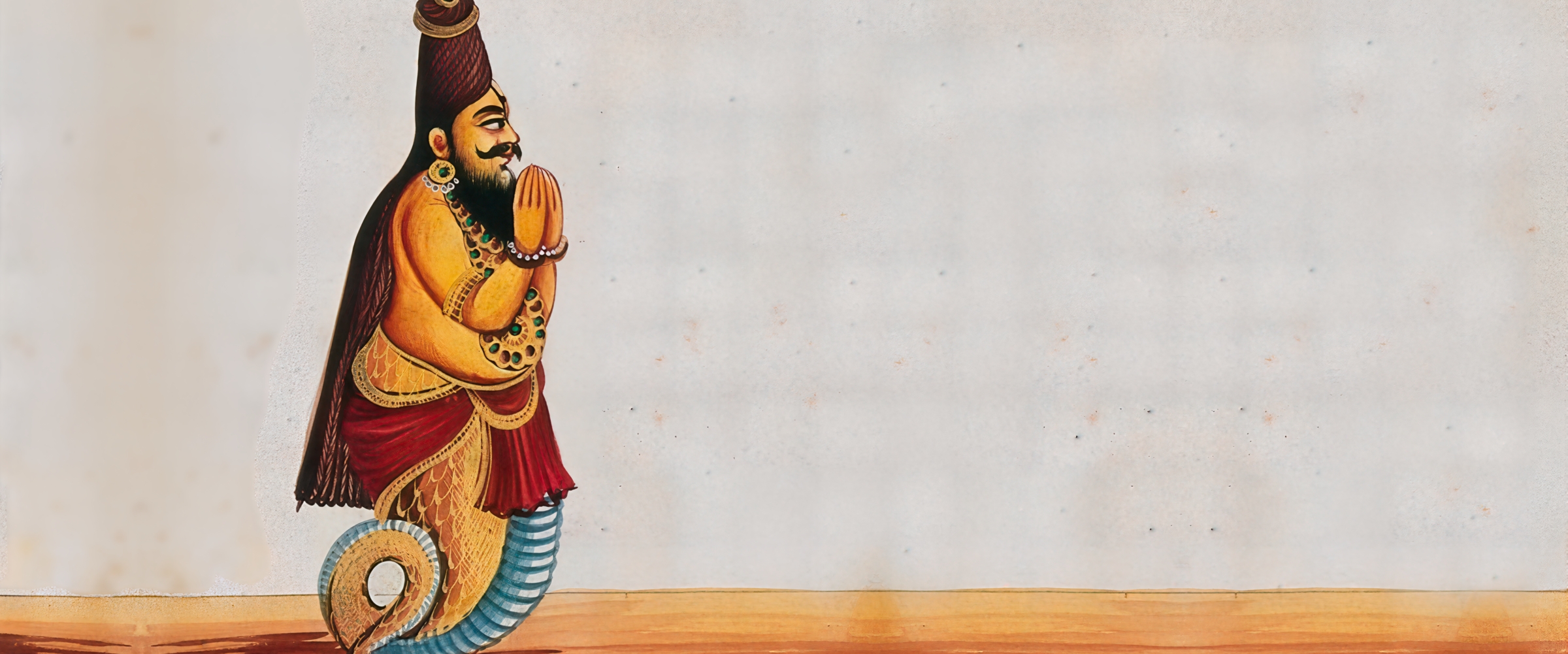
XIII · Patanjali's Yoga Sutras
Let me begin with something that happened to me at the Kumbh Mela in Prayagraj, in 1989. My Siddha Guru, Arjun Puri ji Maharaj, then believed to be well over hundred years old, sat alone on his wooden takat at the first dhuni of the Juna Akhara, as no other living Naga Baba would dare share his gadi. One day a great commotion arose around his dhuni as another yogi had come to sit with him, and hundreds of sadhus were lining up for his darshan, returning from his feet with a wild light in their faces. I joined the queue with eleven rupees in my hand, and when I bent to touch the yogi’s feet the money fell from my fingers, for they were not the feet of a man but the cleft feet of a goat. For a moment the world stood still, and the marrow froze in my bones. That sight changed how I see a yogi. Patañjali (पतञ्जलि) was such a yogi. They say he taught his eighty-one disciples from behind a screen, with one rule, that none might look behind it; and when at last their curiosity overcame them and they looked, they found not a man but the coils of a great serpent where his lower body should be, and for breaking the niyama he burned them to ashes, all but one. Whatever we make of the serpent, it places Patanjali far from the scholar in an air-conditioned office, publishing and competing for an audience. He was a master of speech who set out to compose a text that rings true at whatever level you are able to hear it.
Is such a man the author of his Yoga Sutra, or its rishi, who found what was already there? Patanjali is indeed a rishi of the Vedic tradition; we know he officiated as the chief priest of an Aśvamedha of a king we can date, which is how we fix his own time. Yet his Yoga Sutra is not śruti; he composed it. And he tells us so in his very first line, atha yoga anuśāsana: not the śāsana, the rules of yoga, but the anuśāsana, the teaching as it comes down through an older and larger tradition. His hundred and ninety-five sutras describe that tradition. This is why I hold the physical-culture reading of the Yoga Sutra to be much overblown, and why I will not say that the English translations are false and mine alone is true. A master at the height of his art composes a text that rings true at many levels at once, for the grammarian and for the one who knows no grammar alike.
The work is built as a story is built, with a Setup, a Conflict, and a Resolution. It opens not in striving but in completeness, samādhi, for sam, close to the Latin sum, means the whole and the included; and its main character is citta, which I take for consciousness itself, the “ah” (अः) that is the Citta-śakti of Shiva, the still principle behind all things. To citta is joined vṛtti, the compounding by which consciousness appears to divide and change and put forth a world. A vṛtti is nothing negative; it is an unfolding, an enlargement, a compounding, and it is through vṛttis that the world is made. The commentaries on the Yoga Sutra are themselves called vārtikas, derived from vṛtti. The whole discipline is the nirodha, the reversal of that outward flow back into the seer. So the Conflict of the middle gives way at the end to the Resolution of kaivalya, which is poorly served by “oneness.” I would call it onlyness, not loneliness: that there is nothing else, whether you name the only thing the void or the One.
At the centre of the text stand the eight limbs, the Aṣṭāṅga, and I read each through speech. Yama, the first, is restriction, the playing field, the ultimate restriction that is death itself; its discipline is saṃyama, and its two essential vows are satya, that we work within a field of truth, and ahiṃsā, that we do no violence to the substance of our study (epistemic violence) and so distort that field. Āsana is not the instruction to sit comfortably that the translations make of it. Sthiram sukham āsanam: in the short i (इ) of sthiram and the u (उ) of sukham I hear Icchā Śakti and the Śakti of knowledge, and in the a (अ) of āsanam the Ānanda Śakti, the bliss in which separateness arises and from which all the syllables, all the mātṛkās, are seated. This is the āsana of the mouth. And prāṇāyāma is the regulation of prāṇa, not merely of the breath, though the breath is its sign: the in-breath sounds the unstruck “ah,” the out-breath the unstruck “ha” (ह), and “ah” joined to “ha” is again ahaṃ (अहम्), the I that holds the universe; in the Vedic sense prāṇāyāma carried mantra, the Gāyatrī, the Oṃ (ॐ) Bhur Bhuvah Svah, as penance and invocation.
From there the limbs turn inward. Pratyāhāra, mistaken for the mere withdrawal of the senses, is the withdrawal of a whole field of syllables into their source, the twenty-five consonants of the five vargas, each varga answering to a faculty of perception. Dharana is a covering, as insulation covers a live wire; here the kañcukas close over consciousness and limitation begins, and bliss, once it is measured, becomes emotion, for the root of measure is ma, and maya is simply that which is measured. Dhyana is the heated, hissing syllables, the sibilants that are the very birth of onomatopoeia, the snake’s hiss, rising above the covering to reveal consciousness itself. And so we reach the penultimate syllable Sa (स), the amriteshwar akṣara, the syllable of amrit, which I hear not as infinity but as immortality, standing just before the prāṇic “ha.” Here, at the threshold where application gives way to meaning, Patanjali sets down the sphoṭa (स्फोट), the bursting-forth of meaning that Bhartṛhari takes up next.


