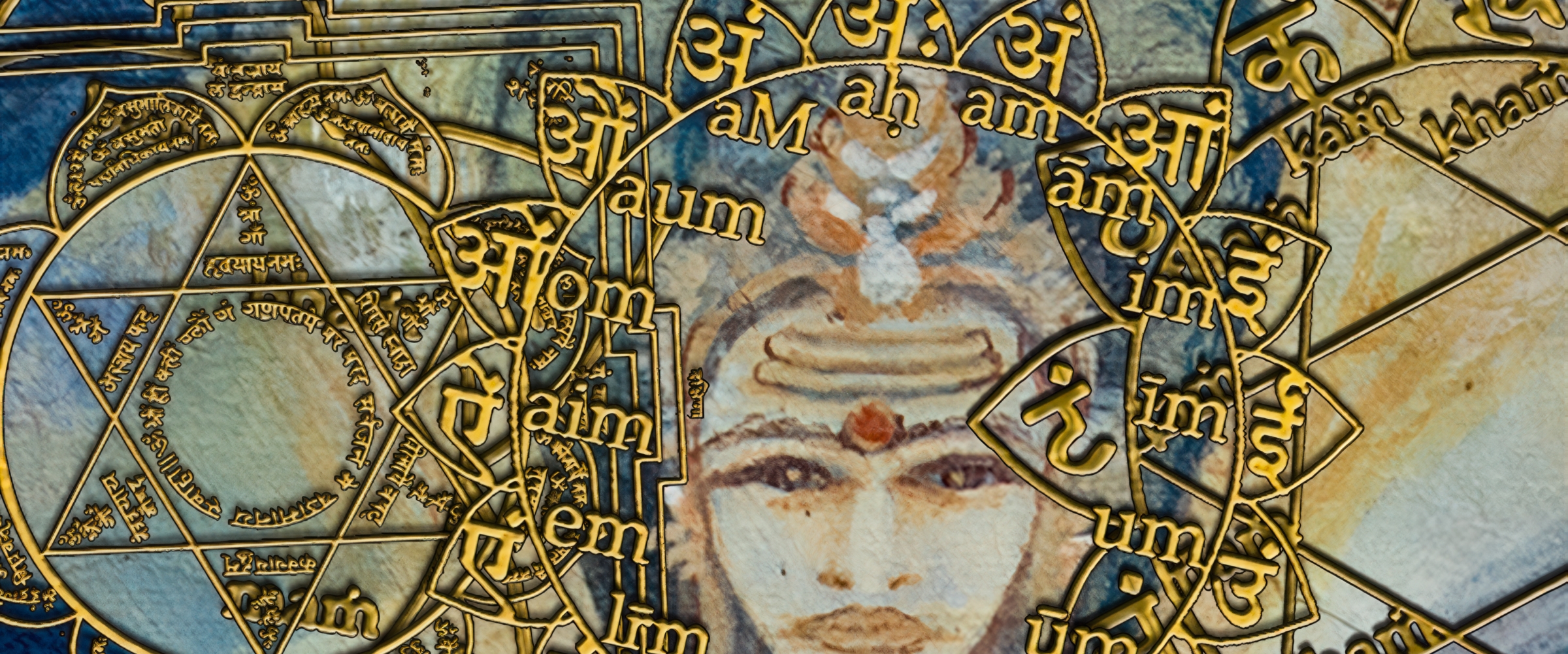
XVII · Kashmiri Shaivism: The 36 Tattvas
There are two ways to come at Kashmiri Shaivism: the academic, which prizes the beauty of the texts and the philosophy, and the applied, the practice, the sādhana. The most published translator, Thakur Jaideva Singh, for all his discipline, treats it as a literary tradition: he speaks of letters where the matter is syllables, of books where the matter is texts. But Abhinavagupta and the Kashmiri gurus, like the Bhartṛharis and Patanjalis and Paninis before them, did not see it so. Much of what is in these texts I know already from my own lineage in the Juna Akhara and from the Nath yogis across North India, and it helps to see what is shared before we ask what, if anything, is unique to Kashmir.
There is a difference of temperament that runs deeper than schools: the mind that goes inward, cleaning and cleaning until only the pure essence is left, and the mind that goes outward until it knows that who we are is bound up with everything we see. What drew me to the Naga Babas, and above all to my own gurus, was an enormous curiosity, a wish to know everything; and I have seen that same hunger in the brightest people I have known. A schoolteacher in Frankfurt, twenty-five years at her work, told me that the children had changed, that once they were curious and now they are not. The one who seeks a single point is the more easily held by ideology and by control; the one who expands to take in the whole cosmos cannot so easily be boxed.
And Kashmiri Shaivism is not so neatly Kashmiri. We honor Abhinavagupta, rightly, for his texts are sublime and his Sanskrit especially rich; but we honor him because his words became manuscripts, and the manuscripts were kept, and at last printed, while somewhere another master as great may have left nothing to be copied. The thinking spread far wider than Kashmir and through far more lineages, through Ujjain, where it ran since Bhartṛhari’s day, and through Kashi. In Varanasi, when I was first there, Swami Karpatri ji put out a journal he called Śabda, word and meaning, and came nearer the living application of Abhinavagupta than the Kashmiris of that time. The thirty-six tattvas that Abhinavagupta sets out are the very ones I was given in the Mahāmṛtyuñjaya sādhana at Ujjain. When a teaching passes from the voice into a manuscript, there is editing, a beginning fixed and an end, a chapter moved, an aside cut, a passage built up; not a sin, but a change, and we must not mistake the edited object for the living transmission.
Here is the thing I want you to remember. We run through the vowels, a (अ), i (इ), u (उ), from the back of the throat to the lips, and through the consonants, ka (क) kha (ख) ga (ग) gha (घ), and it feels so natural and obvious that we call it the natural order. It is not. It is an order we construct with our minds, by the principles of resemblance we took up many sessions ago: ka sits beside kha because they resemble each other. There is more than one such order. Abhinavagupta arranges the syllables in his Mālinī, Pāṇini (पाणिनि) in the fourteen Māheśvara Sūtras (माहेश्वर सूत्र), and each is lawful by resemblance and each is built for application. This is also why I will not call a syllable a letter. A letter only names; the syllable does. Abhinavagupta uses these for doing, and to render them as letters, as Jaideva Singh does, is to mistake the whole enterprise. By his pratyāhāras Panini binds a first syllable to a last and means everything between, and so can call up all the aspirates, or all the nasals, in a breath: speech compressed, a great store of knowledge held in a small sound, the way a single symbol in mathematics can carry a whole law.
The same is true of the bīja, the seed syllable, that invokes a deity within a mantra or a yajña. A bīja does not mean; it does. Like the symbols of a computer language that carry no message yet make the machine work, these are keys, handles, application and not communication, and what knowledge comes of a mantra comes from its use. For the world is not made by sounds, nor by our talk with one another, but by the manifesting of the potentials held in speech, the naming of objects and the forming of ideas. And so the expansion outward, to take in the whole cosmos, turns out to be the path back: to take the totality of speech and follow it down to its source, and to see the world not as something to dispute but as the reflection of that source.
I give you few definitions in these classes, by design; I would rather give you tools, handles, so the work stays yours. So with the word tattva: tat is that, and the ending twa makes a category of it, that-ness, as vyakti is a person and vyaktitva personality. The thirty-six tattvas of Shiva are thirty-six categories, descending from pure consciousness, the least dense, down to the earth, the most dense, each resting on the ones before. We begin with Shiva, pure consciousness, the subject with no object, for there is yet no sentence. Then, for no cause we can name, the Spanda, the stir, by which Shiva desires to know Himself, and His reflection appears in the cosmic mirror: pure consciousness made an object, which is Shakti. From their meeting comes the saying I am this, which is Sadāśiva; and as desire turns to knowledge, the U, the Umeśa, there is Īśvara, in whom the book of the world waits in potential, this is I, idaṃ is ahaṃ; and the balance of the I and the this is Śuddhavidyā. So the cosmos comes down, category by category, out of the single consciousness, by the same movement of speech we have followed from the first session: the One desiring to know itself, and a world unfolding from the word.


