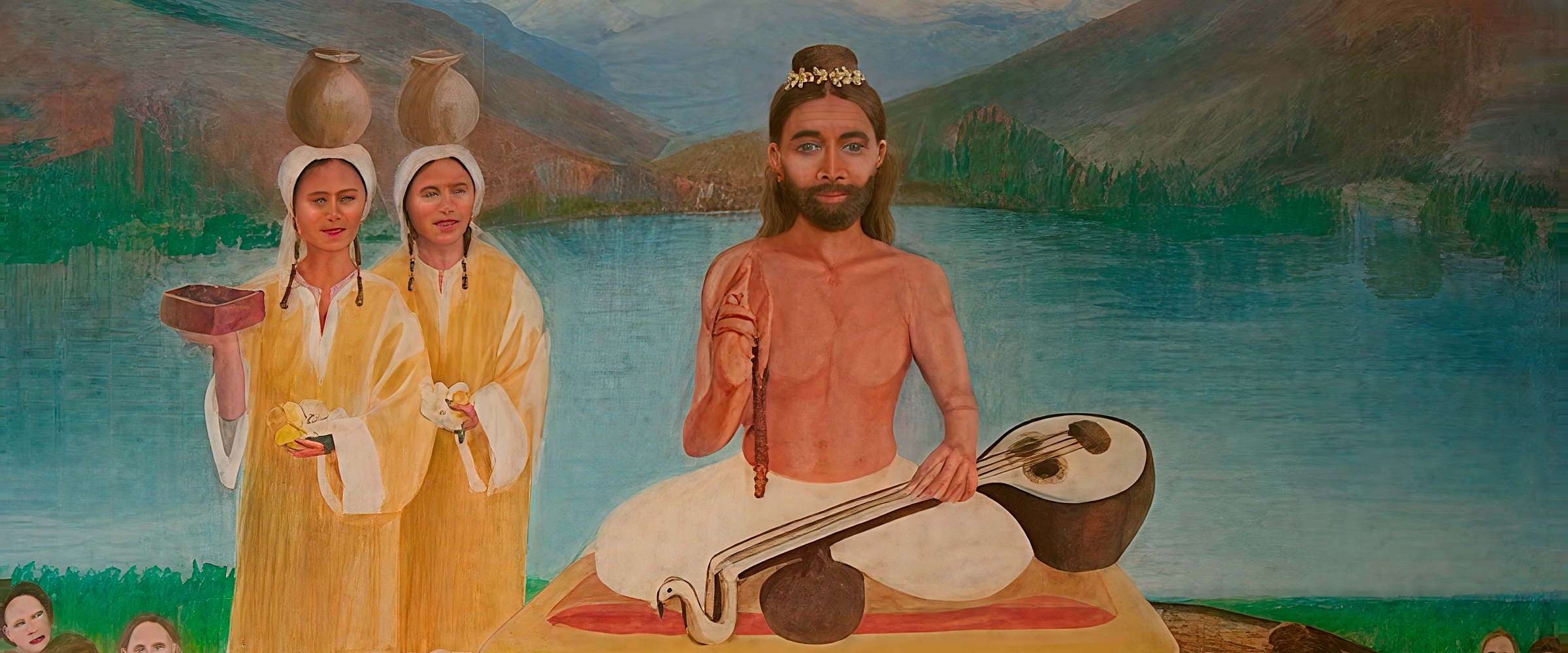
XVI · Kashmiri Shaivism & Abhinavagupta
We come now to Kashmiri Shaivism and to Abhinavagupta, a substantial and much-misread country, and the first thing to know is that it is bound, intimately and intricately, to speech. Abhinavagupta was among the greatest grammarians who ever lived. One of his names is Abhinavagupta Pāda, and Pāda is the honorific we give the greatest saints, whom out of humility we name only by their feet, as we say Bhagavatpada of Śaṅkara; yet Gupta Pāda also means the serpent, and so the name carries a quiet echo of Patañjali (पतञ्जलि), who is himself the serpent, Adishesha, and who, like Abhinavagupta, is called the son of a yogini. The kinship is not only in legend. Helārāja, the foremost commentator on Bhartṛhari, was Abhinavagupta’s guru-brother, and Abhinavagupta composed a great commentary on Bhartṛhari, now lost. He was vastly prolific, more than fifty texts, on Tantra, which is the application of sacred speech, and on poetics, where he carried Bhartṛhari’s teaching, that the unit of meaning is the sentence and not the word, several steps further. The three schools of Kashmiri Shaivism are determined, every one of them, by this single bond of consciousness and speech, and no one studies these texts without first knowing the grammar.
To see what kind of treasure this is, set aside the habit of looking for a message. There are Christian mystics who hold the Bible to be a code concealing God’s secret message to the world, and Muslim mystics who say the same of the Koran, and Aldous Huxley gathered all of it under the name of the perennial philosophy. The Veda is code as well, but it is not message. We no more interpret it for a hidden meaning than we interpret the code that runs a word processor; the worth of that code is that you may run it and write your letter or your book, and the worth of the Veda is in its application, which in the hands of its knowers yields balance and prosperity for a society. Over the code lies an aesthetic, the rhymes and meters, the stories, the gods and goddesses, a whole Vedic world on the surface, and beneath it the meta-language. This is no more a matter of faith than running a program is, and it was from this Veda that Pāṇini (पाणिनि) drew the material of his meta-language. Panini and Patanjali were Brahmin priests, and the purpose of their grammar was to keep this treasure.
Now I must name what stands between us and a thing so sublime. The nineteenth-century study of India, British and German and American, was guided not by the desire to know but by the strategy of empire, and out of it were constructed a Hinduism and a Buddhism that answer to post-Enlightenment categories more than to the people they claim to describe. We run the same risk with Kashmiri Shaivism, which in that sense scarcely exists. And there is a subtler tell. The most accomplished translator of these texts into English, Thakur Jaideva Singh, renders one word, again and again, in a way that gives him away: Akṣara, which means the syllable, the phoneme, he translates as letter. It is the slip of a man who comes to all of this from the written end, as an academic must, for the academy reads texts. But who made the first manuscripts? The disciple and the master needed none; they held it in memory, as your grandmother needed no book to tell you her stories. The manuscripts came later, made for a visiting king or given as a gift, an object rather than the careful passing-down of a tradition; and they were never meant for the beginner, but assumed a hearer already deep in the knowledge, with all the assumptions that, as Bhartṛhari showed us, live beneath the words.
The living lineages of Kashmiri Shaivism are, I believe, now dead. The last master I knew of was Swami Lakshmanjoo of Kashmir, whose darshan I was fortunate to have once or twice in the early seventies; and what struck me in him, as in most great teachers, was that he had no wish to bring anyone into a way of believing. He was a giver of blessings, and his discourses spoke of life and met people where they were, working to remove their ignorance by whatever means came to hand. It is scholars who sort men into schools; a master only articulates the truth, however he can reach you. In his work on the Shiva Sūtras, Lakshmanjoo confessed he feared the tradition would pass with him, and hoped the recordings of his voice might preserve it; yet a recording, even a film of a teacher’s face, still does not answer the need of an oral tradition, and in some ways stands further from it than the printed page, for what such a tradition asks is that people connect with one another.
Through all of it I keep us to the one thread, the bond of speech and consciousness, for the temptation is always to take these tantric texts as ideology rather than as application: how to move from the apparent world inward to the consciousness out of which it is made. We do not close our eyes to the world; the world itself is the tool by which we reach our own identity, and the way of unravelling it back to ourselves is the way of speech, whose essence is sequencing, syllable after syllable, out of which come time, and from time space and the whole phenomenal world. The masters give the handles, how the world is built through that sequencing and how one returns to the source. Kashmir, from the ninth century to the twelfth, was a blossoming of this knowledge; and yet I am a contrarian, for I hold that the fullest manifestation was before Panini, and that we have been in a long devolution ever since, needing ever more commentary, more vṛtti, to reach what was once plain. Bhaṭṭoji Dīkṣita had to redact Panini for the students of his age, which would have been needless in Panini’s time. We are in that same kind of space, and my task with you is to redact this knowledge once more, to reshape it so that it is not lost.
So I do not mean to make Sanskritists of you. We work in Sanskrit because it is the one language I know of with an exact meta-language and a long tradition of commentary; the specifics will not transfer, but the process will, and applying it to your own English or German or any tongue it shows you remarkable things. My own study of Sanskrit is what opened my eyes to my own American English. If this never comes home to our mother languages that we actually speak, it becomes a game, and a futile one. And the stake is real: when speech is corrupted, when the profane speech of the marketplace, of things and ideas and politics, enters our own, it destroys our relationships and our prosperity, as Orwell saw so clearly. This is the whole of why we are here. Not for an academic or a philosophical discussion, but to honor speech, this gift, and through it to make balance and happiness in ourselves and in the world.


